

All Things Are Yours: Drawing from the Deep Well of Christian History
by Gerald L. Sittser
The church has survived, and often thrived, for 2000 years. A lot has happened during this long period of history. The church was birthed in Jerusalem but soon infiltrated the Mediterranean world and beyond. Today it is a global faith, functioning in several thousand languages.
It has diversified along the way, too. Division implies isolation: ordinary Christians are exposed to a small part of the church and its history. Christians are no longer simply Christian. They are Catholic or Reformed or evangelical; Pentecostal or liturgical; and so much more.
Such division can lead to poverty of spirit, especially if Christians stop learning from each other. We attach to one movement or leader, at the exclusion of all others.
This habit goes back a long way. The apostle Paul confronted a similar problem in the church in Corinth. The church had divided into factions. There was the Apollos group, no doubt the intellectuals. There was the Paul group, the innovators that urged the church to push the cultural boundaries. There was the Peter group, the traditionalists that wanted to keep Christianity firmly embedded in Judaism. Finally, and most surprisingly, there was the Christ group that claimed to be the most “spiritual.”
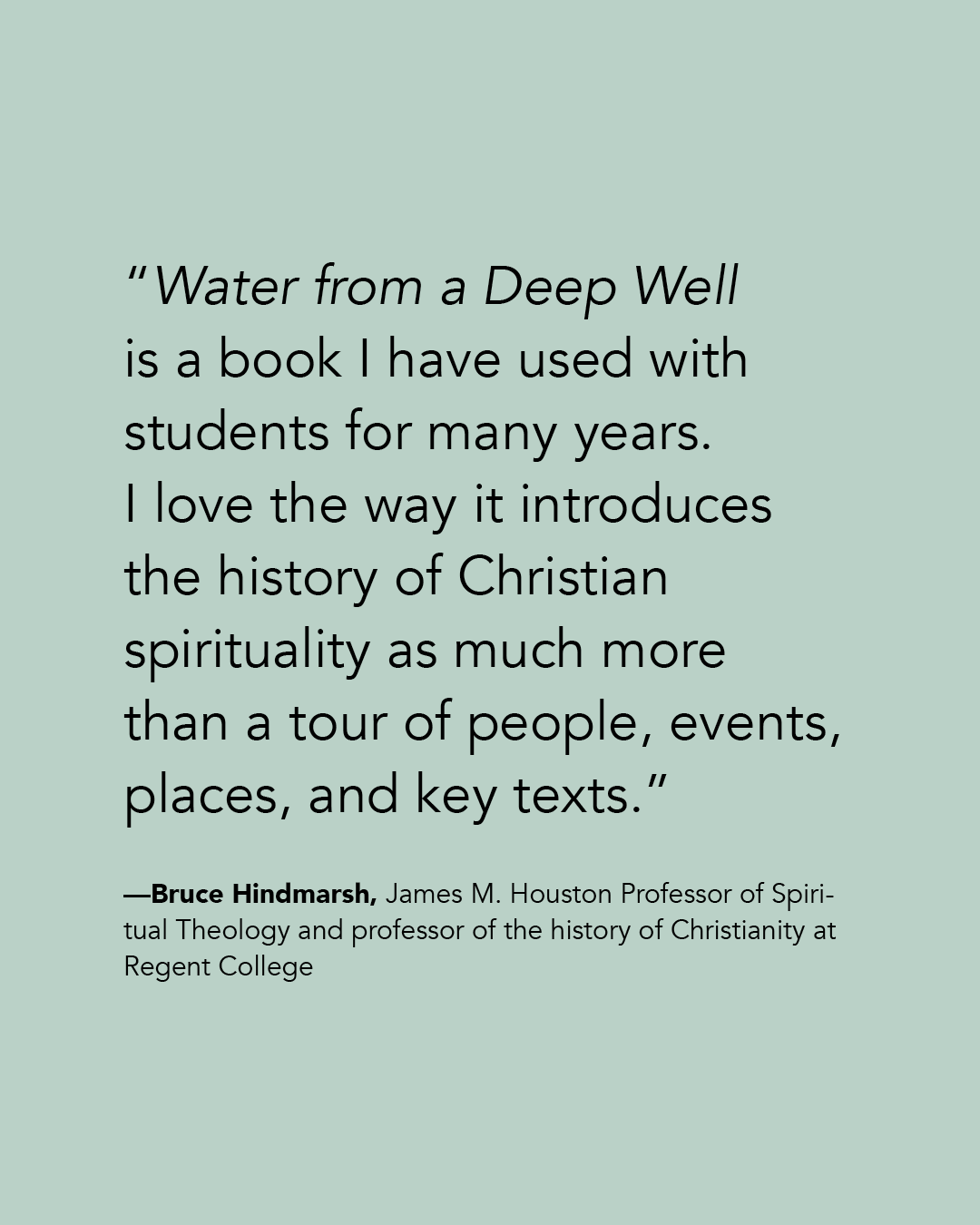
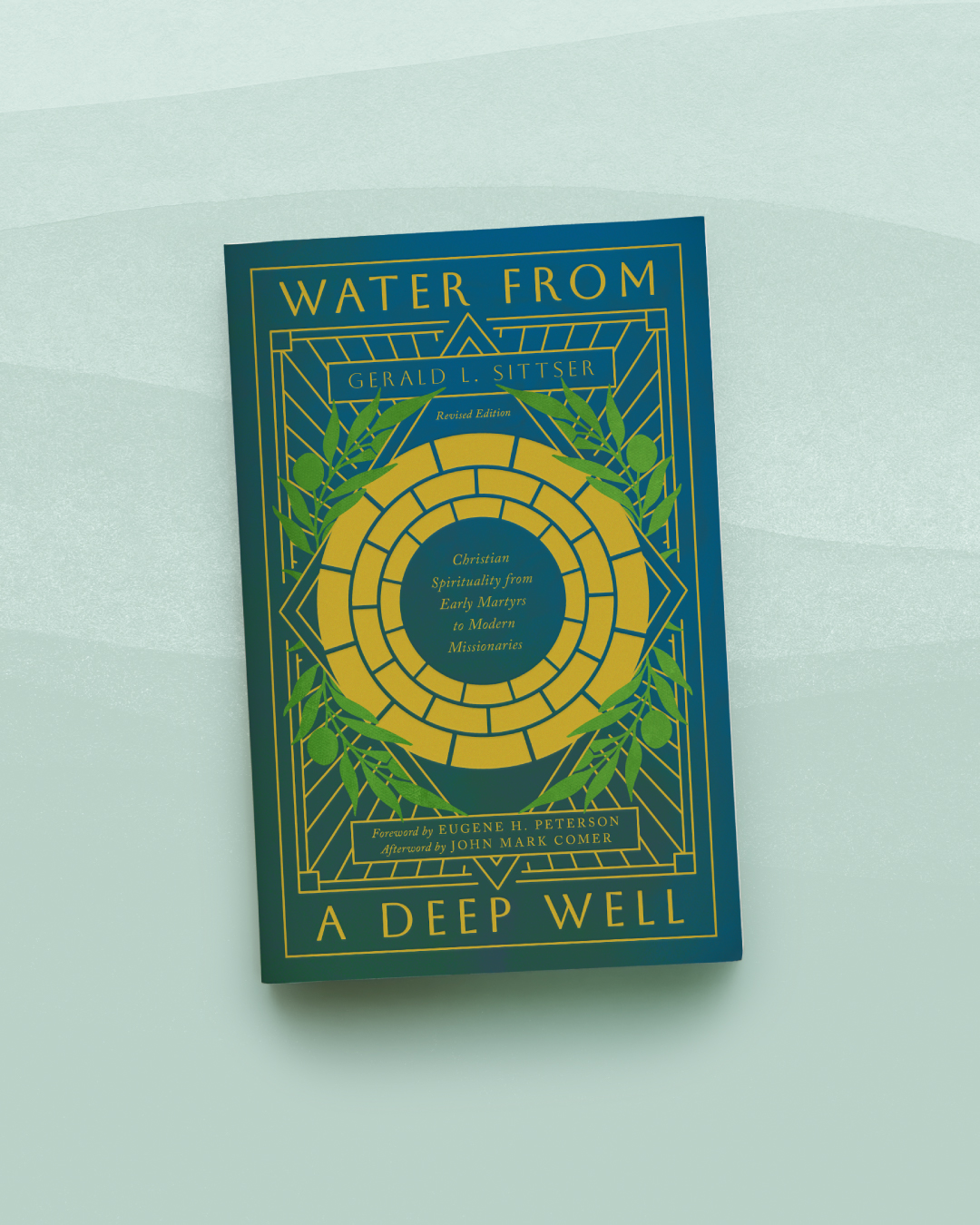
Paul would have none of it. His argument fits the theme of my book, Water from a Deep Well. Apollos, Peter, and Paul were all servants of Christ and his church. Each had a distinct contribution to make. But their purpose was the same, which was to nurture the church toward spiritual maturity: in short, to offer a rich and diverse diet of spiritual food.
Christians in Corinth were cheating themselves by limiting their diet to only one person. As Paul put it, “So let no one boast about people. For all things are yours, whether Paul or Apollos or Cephas or the world or life or death or the present or the future—all are yours, and you are Christ’s, and Christ is God’s” (I Corinthians 3:21-23).
It's all yours, Paul argued. With one qualification—you are not yours. “You are Christ’s, and Christ is God’s.” In truth, Christ is God! In short, Paul reminds us that there is one savior—Jesus Christ—but many teachers; one goal—maturity—but many disciplines to practice; one truth—the historic faith—but many resources in that history available to us. We would be wise to avail ourselves of these resources.
The history of Christian spirituality offers us such resources. The ascetic tradition of the desert fathers and mothers has much to teach us; likewise the monastic movement, medieval sacramentalists and mendicants, Eastern Orthodoxy, the Reformers, evangelicals, and so much more. They are all ours; their theology and practices, their successes and failures, their leaders and critics expose us to the full range of Christian belief and practices. None is exhaustively right; none is completely wrong. They all have something to teach us, provided they point to Jesus as savior and Lord.
“All things are yours!” Polycarp and Macrina the Younger, Macarius of Egypt and Julian of Norwich, Francis, Luther and Menno Simons, Jonathan Edwards and Suzannah Wesley, and so many more. They are ours, and we are Christ’s.
Watch the video series with Gerald Sittser and John Mark Comer from Practicing the Way

Water from a Deep Well
Christian Spirituality from Early Martyrs to Modern Missionaries
by Gerald L. Sittser
Afterword by John Mark Comer
Foreword by Eugene H Peterson
"[This book] is a treasure. The first time I read it, I remember closing the final page and thinking to myself, I wish I could make every single Christian on earth read this book. … John Chrysostom, Evagrius the Solitary, Julian of Norwich, Martin Luther, Dorothy Day, Dietrich Bonhoeffer—these saints and sages live on in me. And they can live on in you, too. They can enlarge and enrich ...
Gerald L. Sittser
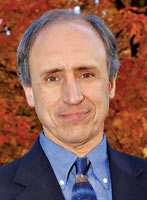
Gerald L. Sittser (PhD, University of Chicago) is professor emeritus of theology at Whitworth University and a senior fellow in the Office of Church Engagement. He is a frequent university lecturer and writer and has authored nine books, includingA Grace Disguised, A Grace Revealed, The Will of God as a Way of Life, Resilient Faith, and A Cautious Patriotism. He is married and has five married children and twelve grandchildren.


