

Search Results
Showing 1 - 10 of 570 results
 Hardback
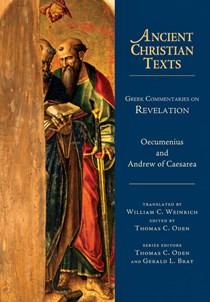
Greek Commentaries on Revelation
Ancient Christian Texts
by Oecumenius and Andrew of Caesarea
Edited by Thomas C. Oden
Translated by William C. WeinrichThe Eastern church gives little evidence of particular interest in the book of Revelation. Oecumenius of Isauria's commentary on the book is the earliest full treatment in Greek and dates only from the early sixth century. Along with Oecumenius'scommentary, only that of Andrew of Caesarea (dating from the same era and often summarizing Oecumenius before offering a contrary opinion) and that of Arethas ...
 Hardback
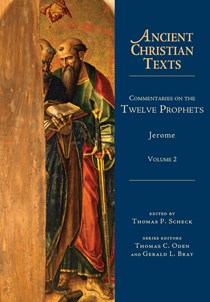
Commentaries on the Twelve Prophets
Volume 2
Ancient Christian Texts
by Jerome
Edited by Thomas P. ScheckJerome (c. 347-419/20), one of the West's four doctors of the church, was recognized early on as one of the church's foremost translators, commentators, and advocates of Christian asceticism. Skilled in Hebrew and Greek in addition to his native Latin, he was thoroughly familiar with Jewish traditions and brought this expertise to bear on his understanding of the Old Testament. Beginning in 379, ...
 Hardback
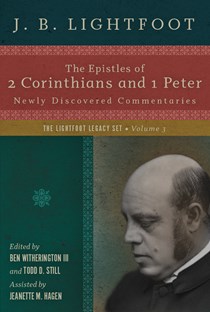
The Epistles of 2 Corinthians and 1 Peter
Newly Discovered Commentaries
The Lightfoot Legacy Set
by J. B. Lightfoot
Edited by Ben Witherington III and Todd D. Still
Assisted by Jeanette M. PiferInterVarsity Press is proud to present The Lightfoot Legacy, a three-volume set of previously unpublished material from J. B. Lightfoot, one of the great biblical scholars of the modern era. In the spring of 2013, Ben Witherington III discovered hundreds of pages of biblical commentary by Lightfoot in the Durham Cathedral Library. While incomplete, these commentaries represent a goldmine for historians ...
 Hardback
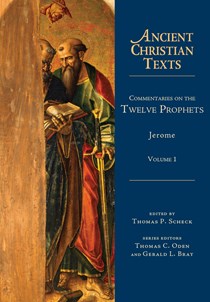
Commentaries on the Twelve Prophets
Volume 1
Ancient Christian Texts
by Jerome
Edited by Thomas P. ScheckJerome (c. 347-419/20), one of the West's four doctors of the church, was recognized early on as one of the church's foremost translators, commentators and advocates of Christian asceticism. Skilled in Hebrew and Greek in addition to his native Latin, he was thoroughly familiar with Jewish traditions and brought them to bear on his understanding of the Old Testament. Beginning in 379, Jerome used ...
 Hardback
Latin Commentaries on Revelation
Ancient Christian Texts
by Victorinus of Petovium, Apringius of Beja, Caesarius of Arles, and Bede the Venerable
Series edited by Thomas C. Oden and Gerald Bray
Edited and Translated by William C. WeinrichInterest in the book of Revelation in the Western tradition is stronger and earlier than that in the East. The earliest full commentary on the Apocalypse is that of Victorinus of Petovium written in the mid to late third century by the earliest exegete to write in Latin. Victorinus interpreted Revelation in millennialist terms, a mode of interpretation already evident in works by Irenaeus, as well ...
 Hardback
Commentaries on Romans, 1-2 Corinthians, and Hebrews
Ancient Christian Texts
by Cyril of Alexandria
Edited by Joel C. Elowsky
Translated by David R. Maxwell"But in fact Christ has been raised from the dead . . ."
Cyril of Alexandria (c. 378–444) was one of the most significant figures in the early church: bishop of the church, defender of orthodoxy, proponent of Alexandrian theology. Indeed, he is probably best known as the supporter of the term Theotokos (God-bearer) with regard to Mary in opposition to Nestorius during ...
 Hardback
Commentaries on Romans and 1-2 Corinthians
Ancient Christian Texts
by Ambrosiaster
Edited and Translated by Gerald BrayAmbrosiaster ("Star of Ambrose") is the name given to the anonymous author of the earliest complete Latin commentary on the thirteen epistles of Paul. The commentaries were thought to have been written by Ambrose throughout the Middle Ages, but their authorship was challenged by Erasmus, whose arguments have proved decisive.
Here for the first time Ambrosiaster's commentaries on Romans and ...
 Hardback
Commentaries on Genesis 1-3
Ancient Christian Texts
by Bede the Venerable and Severian of Gabala
Edited by Michael Glerup
Translated by Carmen S. Hardin and Robert C. HillThe church fathers displayed considerable interest in the early chapters of Genesis, and often wrote detailed commentaries or preached series of homilies on the Hexameron--the Six Days of Creation--among them Eustathius of Antioch, Basil the Great, Gregory of Nyssa, Theodore of Mopsuestia, Ambrose, John Chrysostom and Augustine.
This volume of Ancient Christian Texts offers a first-time English ...
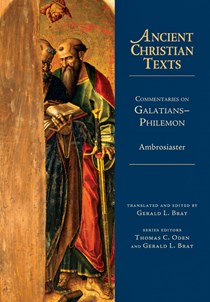 Hardback
Commentaries on Galatians--Philemon
Ancient Christian Texts
by Ambrosiaster
Edited and Translated by Gerald BrayAmbrosiaster ("Star of Ambrose") is the name given to the anonymous author of the earliest complete Latin commentary on the thirteen epistles of Paul. The commentaries were thought to have been written by Ambrose throughout the Middle Ages, but their authorship was challenged by Erasmus, whose arguments have proved decisive.
The commentaries, which serve as important witnesses to pre-Vulgate ...
-
Kidner Classic Commentaries

Discover the Kidner Classic Commentaries, a treasured collection from beloved Old Testament scholar Derek Kidner (1913-2008). For a generation, his commentaries have been a standard for their conciseness, clarity and insight, making biblical texts more accessible. Readers will discover the hallmarks of both scholar and pastor, evidenced by his balanced scholarship and devotional insight.


