

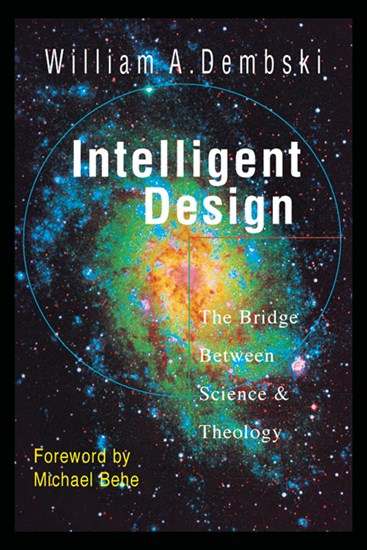
Intelligent Design: The Bridge Between Science  Theology, By William A. Dembski
Intelligent Design
Paperback
  • Length: 312 pages
  • Dimensions: 6 × 9 in
  • Published: July 12, 2002
  • Imprint: IVP Academic
  • ISBN: 9780830823147
  • Voted a 2000 Book of the Year by Christianity Today

The Intelligent Design movement is three things:

  • a scientific research program for investigating intelligent causes
  • an intellectual movement that challenges naturalistic evolutionary theories
  • a way of understanding divine action

Although the fast-growing movement has gained considerable grassroots support, many scientists and theologians remain skeptical about its merits. Scientists worry that it's bad science (merely creationism in disguise) and theologians worry that it's bad theology (misunderstanding divine action). In this book William Dembski addresses these concerns and brilliantly argues that intelligent design provides a crucial link between science and theology. Various chapters creatively and powerfully address intelligent discernment of divine action in nature, why the significance of miracles should be reconsidered, and the demise and unanswered questions of British natural theology. Effectively challenging the hegemony of naturalism and reinstating design within science, Dembski shows how intelligent design can be unpacked as a theory of information. Intelligent Design is a pivotal, synthesizing work from a thinker whom Phillip Johnson calls "one of the most important of the design theorists who are sparking a scientific revolution by legitimating the concept of intelligent design in science."

"There are many things I admire about this book: its thoughtfulness, its philosophical and theological acumen, its willingness to face all difficulties. But the most important contribution is the effort to return the notion of design to its proper standing in science--that is, to bring science back under the rubric of rationality. Naturalism under the guise of science makes a lot of assumptions that it will now be forced to defend instead of assert."Jack Collins, Ph.D., associate profesor of Old Testament, Covenant Theological Seminary, St. Louis, Missouri
"The past twenty years of laboratory research in the biological sciences have unveiled incredible mysteries of nature. Those scientists that have participated in these endeavors have been awestruck not only by the beauty of nature at the molecularlevel but also by the complexity of even the simplest of cells. In fact, scientists adhering to strict Darwinism must remind themselves that what they see is only 'apparent' design. In Dembski's first book, The Design Inference, he laid outthe logic for discriminating 'real' from 'apparent' design. In this new work Dembski unpacks the meaning of 'intelligent design' from the historical, philosophical and theological perspectives. I would encourage even those of my colleagues who disagree with its implications to read and consider the arguments presented in this volume. It promises to be provocative, controversial, but central to the ultimate question of science and religion."Scott A. Minnich, Ph.D., associate professor, department of microbiology, molecular biology and biochemistry, University of Idaho
"If philosophic naturalism is the disease, and I am confident it is, Dembski's Intelligent Design is surely the cure. Extending the argument of his Design Inference, Dembski here traces, in lucid accessible language, the fate of the inference to intelligent cause in Western thought since Bacon. His intellectual history is meticulous, and the positive case he advances for reintroducing design has implications that are radical and far reaching. In his exposition, Dembski exemplifies the finest traditions of the American public intellectual--he assumes that ordinary people, given evidence and argument, are perfectly capable of making reasoned decisions on big questions that matter."John Angus Campbell, professor, department of communications, University of Memphis
"Intelligent design is moving quickly to replace Darwinian evolution as the central guiding principle of biological science. This book is a clear and thought-provoking analysis of the theological, philosophical and scientific aspects of intelligent design by one of its leading proponents. Everyone interested in the coming revolution should read it."Jonathan Wells, postdoctoral biologist and senior fellow at the Discovery Institute, Seattle, Washington
"The toppling of the Berlin Wall will seem small in comparison with the impending demolition of scientific naturalism. Most of us have heard but a rumor of this event with our ears; Dembski is one of those making it happen. Will this be a bad thing? No, a good one. The collapse of the idea that nature is blind, purposeless and 'all there is' will not destroy the scientific study of nature but allow it to come into its own."As a philosopher of the natural moral law, I have particular reason toextol Dembski's work. There would be little point in speaking of a 'law written on the heart' if conscience were merely a meaningless byproduct of selfish genes. Dembski strengthens the case for saying that our deepest moral inclinations not only look designed, they are."J. Budziszewski, departments of government and philosophy, The Univeristy of Texas, and author of Written on the Heart: The Case for Natural Law
"Intelligent Design is a critical resource for anyone who wants to understand the reemergence of the design argument. Dembski has taken the key concepts from his seminal but highly technical work The Design Inference and made them accessible to the average reader. Furthermore, he has placed these arguments in their historical setting, allowing the reader to understand the early development of the design argument, the reasons for its demise for almost 150 years and the critical new insights, which Dembski has helped to fashion, that are responsible for the return of the design argument as an intellectually compelling alternative to naturalism."Walter L. Bradley, professor of mechanical engineering, Texas A M University
"With graduate degrees in mathematics, philosophy and theology, William Dembski is uniquely qualified to address the question of whether divine design is detectable in the realm of nature. His groundbreaking work in design theory is philosophically significant in its own right, but in this book Dembski goes beyond theory to application, claiming that his method, when applied to the natural world of living things, shows in a rigorous way that biological organisms are products of intelligent design."Bold and provocative, Dembski's book challenges the coventional wisdom which says that while science may have input into theology, theology has no input into science. Sooner rather than later, the doyens of contemporary science and religion dialogue will no longer be able to ignore the position Dembski represents, for his work is simply too good for his challenge to stand unanswered."William Lane Craig, fellow of Discovery Institute's Center for the Renewal of Science Culture
More

CONTENTS

Foreword by Michael Behe
Preface
Part 1: Historical Beginnings
1. Recognizing the Divine Finger
1.1 Homer Simpson's Prayer
1.2 Signs in Decision-Making
1.3 Ordinary Versus Extraordinary Signs
1.4 Moses and Pharoah
1.5 The Philistines and the Ark
1.6 The Sign of the Resurrection
1.7 In Defense of Premodernity
2. The Critique of Miracles
2.1 Miracles as Evidence for Faith
2.2 Spinoza's Rejection of Miracles
2.3 Schleiermacher's Assimilation of Spinoza
2.4 Unpacking Schleiermacher's Naturalistic Critique
2.5 Critiquing the Naturalistic Critique
2.6 The Significane of the Naturalistic Critique
3. The Demise of British Natural Theology
3.1 Pauli's Sneer
3.2 From Contrivance to Natural Law
3.3 From Natural Law to Agnosticism
3.4 Darwin and His Theory
3.5 Design and Miracles
3.6 The Presupposition of Positivism
Part 2: A Theory of Design
4. Naturalism Its Cure
4.1 Nature and Creation
4.2 The Root of Idolatry
4.3 Naturalism Within Western Culture
4.4 The Cure: Intelligent Design
4.5 Not Theistic Evolution
4.6 The Importance ofDefinitions
4.7 A New Generation of Scholars
5. Reinstating Design Within Science
5.1 Design's Departure from Science
5.2 Why Reinstate Design?
5.3 The Complexity-Specification Criterion
5.4 Specification
5.5 FalseNegatives and False Positives
5.6 Why the Criterion Works
5.7 Irreducible Complexity
5.8 So What?
6. Intelligent Design as a Theory of Information
6.1 Complex Specified Information
6.2 Generating Information via Law
6.3 Generating Information via Chance
6.4 Generating Information via Law and Chance
6.5 The Law of Conservation of Information
6.6 Applying the Theory to Evolutionary Biology
6.7 Reconceptualizing Evolutionary Biology
Part 3: Bridging Science Theology
7. Science Theology in Mutual Support
7.1 Two Windows on Reality
7.2 Epistemic Support
7.3 Rational Compulsion
7.4 Explanatory Power
7.5 The Big Bang and Divine Creation
7.6 Christ as the Completion of Science
8. The Act of Creation
8.1 Creation as a Divine Gift
8.2 Naturalism's Challenge to Creation
8.3 Computational Reductionism
8.4 Our Empirical Selves Versus Our Actual Selves
8.5 The Resurgence of Design
8.6 The Creation of the World
8.7 The Intelligibility of the World
8.8 Creativity, Divine and Human
Appendix: Objections to Design
A.1 The God of the Gaps
A.2 Intentionality Versus Design
A.3 Scientific Creationism
A.4 But Is It Science?
A.5 Dysteleology
A.6 Just an Anthropic Coincidence
A.7 Applying the Math to Biology
A.8 David Hume's Objections
A.9 Mundane Versus Trancendant Designers
Notes
Index

More

You May Also Like

William A. Dembski

William Dembski (Ph.D., mathematics, University of Chicago; Ph.D., philosophy, University of Illinois at Chicago) is senior fellow of the Discovery Institute's Center for Science and Culture. He has previously taught at Northwestern University, the University of Notre Dame, and the University of Dallas. He has done postdoctoral work in mathematics at MIT, in physics at the University of Chicago, and in computer science at Princeton University, and he has been a National Science Foundation doctoral and postdoctoral fellow. Dembski has written numerous scholarly articles and is the author of the critically acclaimed The Design Inference (Cambridge), Intelligent Design (InterVarsity Press) and No Free Lunch: Why Specified Complexity Cannot Be Purchased without Intelligence (Rowman and Littlefield).