

|
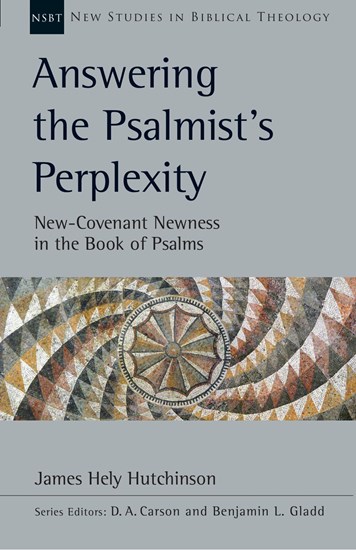
Answering the Psalmist's Perplexity
Paperback
|
- Length: 272 pages
- Dimensions: 5.5 × 8.5 in
- Published: January 09, 2024
- Imprint: IVP Academic
- ISBN: 9781514008867
-
Available at all major retailers!
Amazon
Barnes & Noble
Bookshop.org
"Give thanks to YHWH, for he is good, for his covenant faithfulness endures for ever" (Ps 136:1).
There are now numerous models that seek to explain how the biblical covenants relate to one another. In an attempt to evaluatethese models, James Hely Hutchinson mines the rich seams of the book of Psalms in this New Studies in Biblical Theology volume.
After covering the key data on covenant relationships in Books 1–3 of the psalter, Hutchinson considers the perplexity expressed in the pivotal Psalm 89: in the face of the exile, the promises to David appear to be null and void. The building blocks of the solution lie with the first five books of the Bible, chiefly with the inviolable character of the promises to Abraham. However, if the Abrahamic covenant is to reach fulfilment, the problem of sin must be dealt with once and for all, and a glorious new-covenant regime must be established in which a host of covenants converge in their fulfilment. Central to this regime, which lies beyond the exile, is the eternal rule of David's superior, righteous seed and son who is also a perpetual priest and a suffering servant.
Identifying new-covenant newness as "eschatological satisfaction (fulfilment)" and "transcendent inauguration," Hutchinson tackles a range of matters that contribute to our understanding of the contours of redemptive history, with the overall aim to enhance readers' grasp of God's breathtaking salvation plan, ability to handle Scripture aright, and worship of the Master.
Addressing key issues in biblical theology, the works comprising New Studies in Biblical Theology are creative attempts to help Christians better understand their Bibles. The NSBT series is edited by D. A. Carson and Benjamin L. Gladd, aiming to simultaneously instruct and to edify, to interact with current scholarship and to point the way ahead.

CONTENTS
Illustrations
Series preface
Author’s preface
Abbreviations
1. This study’s viability and method
2. The covenant-relationships spectrum
3. Scene-setting for the psalmist’s perplexity (Psalms 1–89)
4.The building blocks of the answer in book 4
5. The outworking of the answer in book 5
6. The law and the new-covenant believer’s ethical life
7. Summary and conclusions
Appendix 1: Hierarchy of key indicators of Psalter shape/shaping
Appendix 2: A second example of ambiguity between YHWH and his king in a prophecy concerning the new covenant
Appendix 3: Second possible explanation of the relationship between Psalm 106 and 1 Chronicles 16
Appendix 4: Meaning of ‘Of David’ after Psalm 72:20
Appendix 5: Referent of the first-person plural in Psalm 117:2
Bibliography


