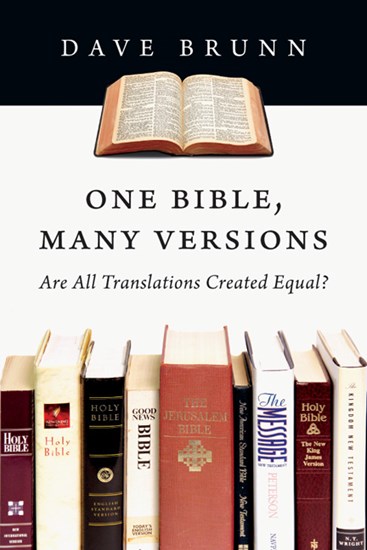
"In this book Dave Brunn raises the important and fascinating question, how literal should a Bible translation be? As there is no universal agreement on the answer to this question and as the issue is of considerable importance his work is timely and should prove helpful to pastors, translators and all who seek to 'rightly handle the Word of God.'"Stuart Briscoe, minister-at-large, Elmbrook Church
"Drawing on fascinating insights from his Bible translation work among the Lamogai people of Papua New Guinea and on hundreds of carefully collated examples from leading English versions, Dave Brunn demonstrates persuasively that, in translating the Bible, meaning should trump form--and usually does, regardless of the translators' theoretical preferences. Emphasizing the shared translation techniques and the complementary value of available English translations, he issues a much-needed plea to value these rich resources for better understanding God's Word rather than continuing to argue about the 'right' way to translate it."Richard Schultz, Wheaton College
"This book is a significant contribution to fostering Christian unity by promoting better understanding of the translation process and of the common values that are shared by the translators of different versions. With numerous convincing examples, the author demonstrates how versions that claim to be 'literal' and those that claim to be 'dynamic' share the goals of accuracy to the original text and of effective communication, though often with varying focuses and different audiences in mind. Such different perspectives can be an enhancement, facilitating a better understanding of the biblical text, rather than being a cause of division."Katharine G. L. Barnwell, international translation consultant, Summer Institute of Linguistics
"The gospel was originally spoken to us in the historically conditioned forms of the Hebrew, Aramaic and Greek languages of antiquity, and the Lord commanded us to pass that gospel on to all nations until the end of the age. Faithful and reliable translations of those Scriptures are the essence of obedience to that commandment. And what a task it is! Translation is the responsibility of the entire church even if in particular ways it is the labor of specialized professionals. Ultimately the work of translating the Bible into English, to limit ourselves to this one language, requires knowledge across a range of fields, among which are translation theory, the original languages of Scripture, the English language, linguistics, exegesis and theology, and the history, aims and users of previous and existing English translations--not to mention a stance of faithfulness from within the life of that very gospel. It is to be expected that so great a task would strain our best minds,and it is understandable if it should occasion principled disagreement. For the non-specialist some of this disagreement is bound to breed uncertainty. Understanding and confidence are what we seek. What is therefore to be hoped is that a voice suchas Dave Brunn's will be heard, combining as it does theoretical and practical knowledge with a spirit of charity, peace and faithful devotion. Among his credentials, Brunn spent two decades translating the Scriptures into a language outside the Indo-European family to which English belongs, affording him invaluable comparative perspective. To this he adds the graces of a gifted teacher: clarity, patience, humility and remarkable empathy for readers who have little or no experience in the languages and other challenges of translation. Easy-to-understand charts and illustrations abound. Moreover, his aims are not bound up with any particular translation but with the interests of the church and the gospel. Without presuming to have written the final word, Brunn has written a good book and modeled for us how to have a conversation."Jon Laansma, Wheaton College and Graduate School