

Search Results
Showing 251 - 260 of 424 results
 Paperback
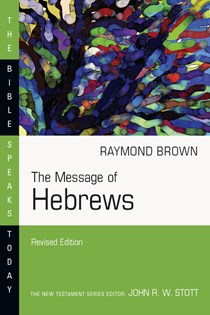
The Message of Hebrews
The Bible Speaks Today Series
by Raymond Brown
The first-century readers of Hebrews were at a critical point. Many had been exposed to public ridicule, persecution, and imprisonment. Some had already abandoned their commitment to Christ, and others were in danger of compromising or giving up. The letter to the Hebrews brought a profound encouragement and appeal: they must keep their eyes on Christ and remain anchored in the ...
 Paperback
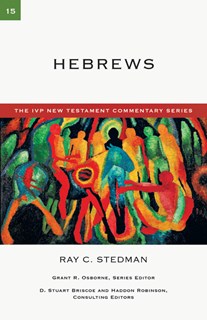
Hebrews
A Commentary on the New Testament
The IVP New Testament Commentary Series
by Estate of Ray C. Stedman
For people beginning to doubt the uniqueness and supremacy of Christ, the author of the book of Hebrews provided one of the longest, most profound arguments in the New Testament. Christians today will find their understanding stretched and their loyalty confirmed by this rich presentation of our great High Priest, the Son of God, whose sacrifice of himself took away our sins and gave us continual ...
 Paperback
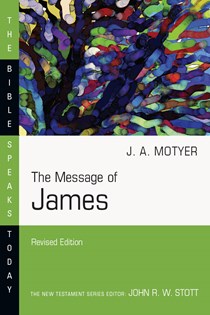
The Message of James
The Bible Speaks Today Series
by J. A. Motyer
The apostle James addressed his readers directly and pointedly, using vivid images from ordinary life and attention-gripping statements. His letter reveals how a genuine faith is a tested faith, and how encountering difficulties is an essential part of the growth to Christian maturity.
In this Bible Speaks Today volume, J. Alec Motyer's rich exposition brings James's letter ...
 Paperback
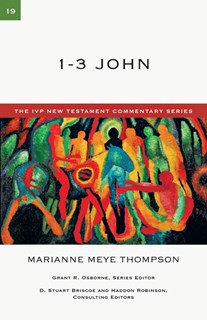
1-3 John
A Commentary on the New Testament
The IVP New Testament Commentary Series
by Marianne Meye Thompson
Torn by conflict, the congregation to whom John addressed his letters stood in need of his strong exhortations to love and unity within the bounds of truth. His word to them is well suited to the church today, confronted by controversies within and without that challenge its ability and will to stand for the truth in a pluralistic society.In this careful study of John's letters, readers will find ...
 Hardback
Psalms 1-50
Volume 7
Ancient Christian Commentary on Scripture
Edited by Craig A. Blaising and Carmen S. Hardin
General Editor Thomas C. OdenThe Psalms have long served a vital role in the individual and corporate lives of Christians, expressing the full range of human emotions, including some that we are ashamed to admit. The Psalms reverberate with joy, groan in pain, whimper with sadness, grumble in disappointment, and rage with anger.
The church fathers employed the Psalms widely. In liturgy they used them ...
 Paperback
The Message of Philippians
The Bible Speaks Today Series
by J. A. Motyer
Paul wrote his letter to the Philippians while he was in prison, but it contains no hint of self-pity. Instead, the letter radiates joy—joy that Christ was proclaimed, joy in fellowship with the Philippian Christians, and above all, joy in Jesus himself.
In this Bible Speaks Today volume, J. A. Motyer identifies three major themes that filled Paul's heart and mind as he wrote: ...
 Hardback
We Believe in One God
Ancient Christian Doctrine Series
Edited by Gerald Bray
"We believe in one God, the Father." The opening clause of the Nicene Creed can be summed up in a single word—monotheism. In the early centuries of the church, this striking doctrine stood starkly against a cultural background of multiple deities and spiritual powers. While it clearly builds on its Jewish heritage, calling God "Father" anticipates the Father-Son relationship ...
 Hardback
We Believe in One Lord Jesus Christ
Ancient Christian Doctrine Series
Edited by John Anthony McGuckin
"Who do you say that I am?" This question that Jesus asked of his disciples, so central to his mission, became equally central to the fledgling church. How would it respond to the Gnostics who answered by saying Jesus was less than fully human? How would it respond to the Arians who contended he was less than fully God? It was these challenges that ultimately provoked the Council ...
 Hardback
We Believe in the Crucified and Risen Lord
Ancient Christian Doctrine Series
Edited by Mark J. Edwards
The resurrection changed everything. "But for the resurrection," writes Mark J. Edwards, "there would have been no reason to argue for a union of two natures in the person of Christ, let alone for a dyad or triad in the Godhead. All that he had said and done in the course of his earthly ministry would have sat well enough with the character of a prophet who excelled such predecessors ...
 Hardback
We Believe in the Holy Spirit
Ancient Christian Doctrine Series
Edited by Joel C. Elowsky
General Editor Thomas C. Oden"The Spirit blows where it pleases," Jesus said to Nicodemus. "You hear its sound but you cannot tell where it comes from or where it is going. So it is with everyone born of the Spirit."
The Spirit, like the wind, is hard to pin down. Any discussion of the Spirit is fraught with the difficulty of speaking about something or someone who defies definition and who purposely ...


