

Search Results
Showing 161 - 170 of 424 results
 Hardback
Romans 1-8
New Testament Volume 7
Reformation Commentary on Scripture
by Gwenfair Walters Adams
"If we have been united with him in a death like his, we shall certainly be united with him in a resurrection like his." (Rom. 6:5) With its themes of grace, sin, justification, and salvation through Christ alone, Paul's letter to the early church in Rome has been a primary focus of Christian reflection throughout church history. Sixteenth-century reformer Martin Luther reflected ...
 Hardback
2 Corinthians
New Testament Volume 9B
Reformation Commentary on Scripture
Edited by Scott M. Manetsch
"Therefore, if anyone is in Christ, he is a new creation. The old has passed away; behold, the new has come."
When the Reformers of the sixteenth century turned to this biblical text, originally written by Paul to the first-century church in Corinth, they found truths that apply to Christians regardless of their historical context. For example, Reformed theologian Wolfgang ...
 Hardback
Galatians, Ephesians
New Testament Volume 10
Reformation Commentary on Scripture
Edited by Gerald Bray
The gospel of justification by faith alone was discovered afresh by the Reformers in the epistolary turrets of the New Testament: the letters to the Galatians and the Ephesians. At the epicenter of the exegetical revolution that rocked the Reformation era was Paul's letter to the Galatians. There Luther, Calvin, Bullinger and scores of others perceived the true gospel of Paul enlightening a situation ...
 Hardback
Isaiah 1–39
Old Testament Volume 10A
Reformation Commentary on Scripture
Edited by Jeffrey Fisher
"And I heard the voice of the Lord saying, 'Whom shall I send, and who will go for us?'
Then I said, 'Here I am! Send me.'"
In his interpretation of Isaiah's vision of God and subsequent sending, the Anabaptist reformer Menno Simons perceived a pattern for all prophets, apostles, ministers, and preachers who are called and then sent out to spread the ...
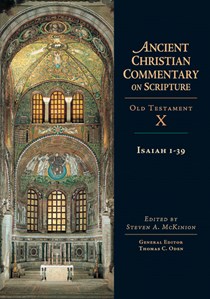 Hardback
Isaiah 1-39
Volume 10
Ancient Christian Commentary on Scripture
Edited by Steven A. McKinion
General Editor Thomas C. OdenFor to us a child is born,
to us a son is given;
and the government will be upon his shoulder
and his name shall be called
"Wonderful Counselor, Mighty God,
Everlasting Father, Prince of Peace."For the early church fathers the prophecy of Isaiah was not a compendium of Jewish history or theology but an announcement of the coming Messiah fulfilled in the life and ministry ...
 Paperback
Isaiah 1-39
Volume 10
Ancient Christian Commentary on Scripture
Edited by Steven A. McKinion
General Editor Thomas C. OdenFor to us a child is born,
to us a son is given;
and the government will be upon his shoulder
and his name shall be called
"Wonderful Counselor, Mighty God,
Everlasting Father, Prince of Peace."For the early church fathers the prophecy of Isaiah was not a compendium of Jewish history or theology but an announcement of the coming Messiah fulfilled in the life and ministry ...
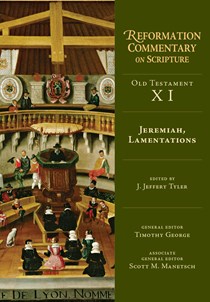 Hardback
Jeremiah, Lamentations
Old Testament Volume 11
Reformation Commentary on Scripture
Edited by J. Jeffery Tyler
The prophetic ministry of Jeremiah, described in the Old Testament books of Jeremiah and Lamentations, took place during a time of chaos and tragedy for the people of Israel: the fall of Jerusalem, the destruction of the temple, and the exile to Babylon. Yet, in the midst of this loss and in hope of the restoration of God's people, Jeremiah is able to declare: "The steadfast love of the Lord never ...
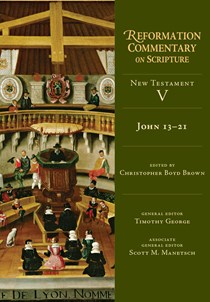 Hardback
John 13-21
Reformation Commentary on Scripture
Edited by Christopher B. Brown
After he had washed the disciples' feet, Jesus said, "Just as I have loved you, you also are to love one another."
The second half of the Gospel of John, sometimes called the most "theological" of the Gospels, includes John's account of Jesus' final night with his disciples, his betrayal and arrest, his crucifixion, his resurrection, and his appearances to his disciples.
When ...
 Hardback
Romans 9-16
New Testament Volume 8
Reformation Commentary on Scripture
Edited by Philip D. W. Krey and Peter D. S. Krey
Writing to the early Christians in Rome, the apostle Paul said, "Do not be conformed to this world, but be transformed by the renewal of your mind, that by testing you may discern what is the will of God, what is good and acceptable and perfect" (Rom 12:2 ESV). Perhaps more than any other New Testament epistle, Paul's letter to the Romans has been the focus of Christian reflection throughout the ...
 Hardback
Hebrews, James
New Testament Volume 13
Reformation Commentary on Scripture
by Ronald K. Rittgers
“Faith is the assurance of things hoped for, the conviction of things not seen,” wrote the author of the epistle to the Hebrews. Reflecting on this verse and the epistle’s description of the high priestly and sacrificial ministry of Jesus Christ,Swiss Reformed theologian and exegete Heinrich Bullinger defined faith as “the most constant mental certainty, which rests on those things to which all ...


