

Search Results
Showing 91 - 100 of 424 results
 Ebook
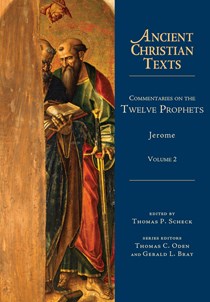
EbookCommentaries on the Twelve Prophets
Ancient Christian Texts
by Jerome
Edited by Thomas P. ScheckJerome (c. 347-419/20), one of the West's four doctors of the church, was recognized early on as one of the church's foremost translators, commentators, and advocates of Christian asceticism. Skilled in Hebrew and Greek in addition to his native Latin, he was thoroughly familiar with Jewish traditions and brought this expertise to bear on his understanding of the Old Testament. Beginning in 379, ...
 Ebook
EbookGreek Commentaries on Revelation
Ancient Christian Texts
by Oecumenius and Andrew of Caesarea
Edited by Thomas C. Oden
Translated by William C. WeinrichThe Eastern church gives little evidence of particular interest in the book of Revelation. Oecumenius of Isauria's commentary on the book is the earliest full treatment in Greek and dates only from the early sixth century. Along with Oecumenius'scommentary, only that of Andrew of Caesarea (dating from the same era and often summarizing Oecumenius before offering a contrary opinion) and that of Arethas ...
 Ebook
EbookLatin Commentaries on Revelation
Ancient Christian Texts
by Victorinus of Petovium, Apringius of Beja, Caesarius of Arles, and Bede the Venerable
Series edited by Thomas C. Oden and Gerald Bray
Edited and Translated by William C. WeinrichInterest in the book of Revelation in the Western tradition is stronger and earlier than that in the East. The earliest full commentary on the Apocalypse is that of Victorinus of Petovium written in the mid to late third century by the earliest exegete to write in Latin. Victorinus interpreted Revelation in millennialist terms, a mode of interpretation already evident in works by Irenaeus, as well ...
 Ebook
EbookCommentaries on Romans and 1-2 Corinthians
Ancient Christian Texts
by Ambrosiaster
Edited and Translated by Gerald BrayAmbrosiaster ("Star of Ambrose") is the name given to the anonymous author of the earliest complete Latin commentary on the thirteen epistles of Paul. The commentaries were thought to have been written by Ambrose throughout the Middle Ages, but their authorship was challenged by Erasmus, whose arguments have proved decisive.
Here for the first time Ambrosiaster's commentaries on Romans and ...
 Ebook
EbookCommentaries on Genesis 1-3
Ancient Christian Texts
by Bede the Venerable and Severian of Gabala
Edited by Michael Glerup
Translated by Carmen S. Hardin and Robert C. HillThe church fathers displayed considerable interest in the early chapters of Genesis, and often wrote detailed commentaries or preached series of homilies on the Hexameron--the Six Days of Creation--among them Eustathius of Antioch, Basil the Great, Gregory of Nyssa, Theodore of Mopsuestia, Ambrose, John Chrysostom and Augustine.
This volume of Ancient Christian Texts offers a first-time English ...
 Paperback
Esther
An Introduction and Commentary
Tyndale Old Testament Commentaries
by Debra Reid
The place: Persia. The time: fifth-century BC. The Jews were threatened with genocide. A decree ordered the extermination of young and old, women and children. The book of Esther describes how this crisis was averted through the bravery of Esther,the wisdom of Mordecai and the unity of the Jewish people. Debra Reid's approachable commentary helps us see even more clearly in the book of Esther the ...
 Paperback
The Message of Genesis 1–11
The Bible Speaks Today Series
by David J. Atkinson
Where do we come from? What is our purpose? The key to how and why we are is found in the early chapters of Genesis.In The Message of Genesis 1–11, David Atkinson explores how the first eleven chapters serve as an overture to the rest of the Bible. They evoke wonder as God is portrayed in his creative power and beauty. They reveal God's loving mercy and salvation, even ...
 Paperback
The Message of Genesis 12–50
The Bible Speaks Today Series
by Joyce G. Baldwin
Genesis sets the scene for the whole of the Bible, and indeed the entire human drama. It is a book both of beginnings and of a new beginning—the dawn of the gospel.In this Bible Speaks Today commentary, Joyce G. Baldwin shows howthe vivid narratives of Abraham, Isaac, Jacob, and Joseph still speak to us today, highlighting God's ways of dealing with ordinary, imperfect people in ...
 Paperback
The Message of Exodus
The Days of Our Pilgrimage
The Bible Speaks Today Series
by J. A. Motyer
The whole story of the book of Exodus is a covenant narrative. In Moses' story, the pledges that God made to Abraham are honored and fulfilled as the Israelites are saved from Egypt and guided to the promised land.In this Bible Speaks Today volume, J. Alec Motyer explores what this key part of Scripture testifies about the God of the Bible. Considering the meaning that Exodus still ...
 Paperback
The Message of Leviticus
Free to Be Holy
The Bible Speaks Today Series
by Derek Tidball
For many Christians, the book of Leviticus is largely unknown and unread. Yet this book is crucial for understanding the rest of the Bible and the nature of the gospel.In this Bible Speaks Today volume, Derek Tidball shows how this vital part of Scripture is of foundational importance for our view of God and Christian living. Revealing the original message to the people of Israel ...


